Zero Trust architecture has traditionally been discussed in terms of identity, device posture and network access.
Enterprise browsers introduce another control point: the user interaction layer itself.
That changes the architectural question.
Instead of asking only:
How should traffic be inspected and routed before it reaches an application?
we can also ask:
What should the user be allowed to do once the application session already exists?
The network-centric model
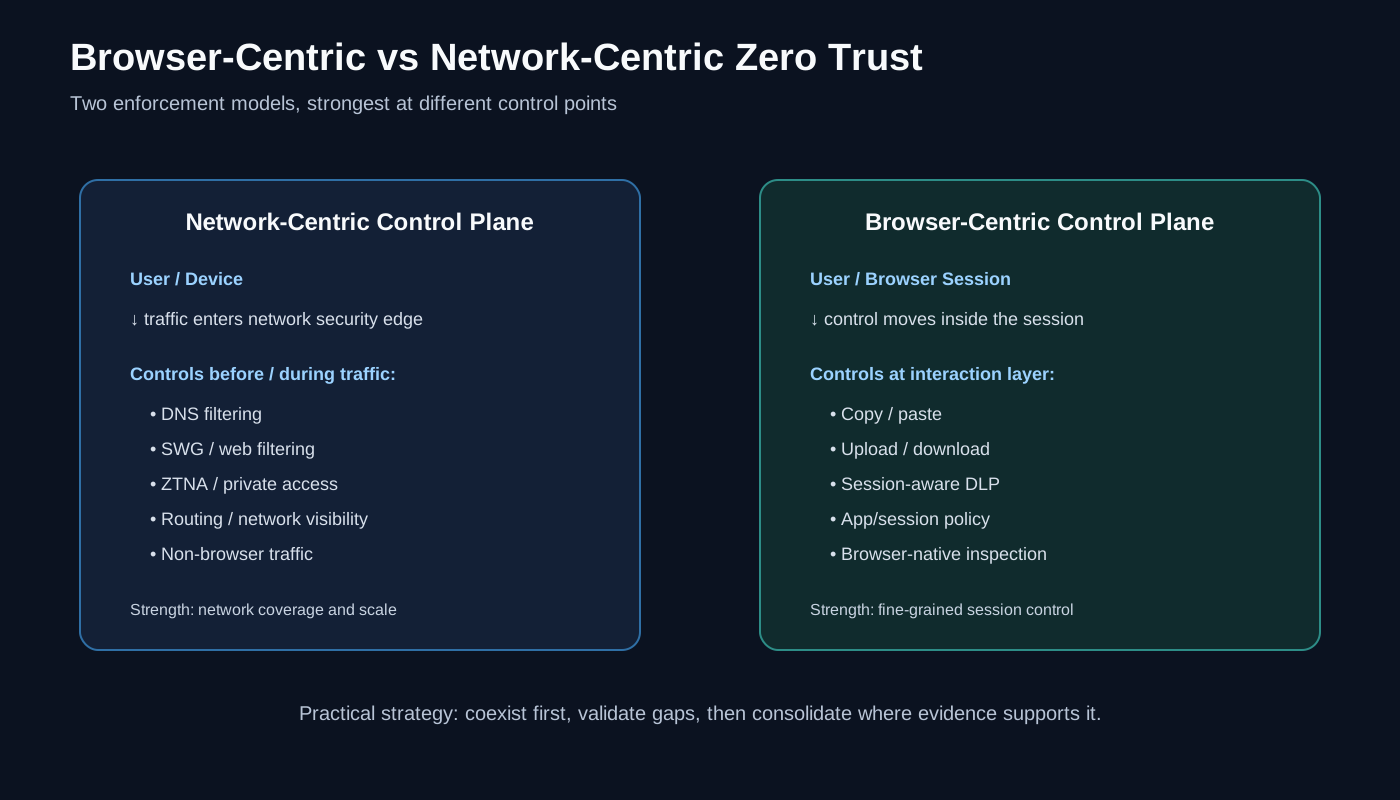
A network-centric Zero Trust platform is strongest when the control needs to apply to traffic regardless of which application generated it.
Typical controls include:
- DNS filtering
- Secure Web Gateway policy
- private application access
- network routing
- device-to-network segmentation
- non-browser application traffic
- consistent inspection at a shared edge
The enforcement point is normally before or during the network flow.
That makes the model powerful for broad coverage.
It also means the platform sees the connection rather than necessarily understanding every user interaction that occurs inside the application.
The browser-centric model
An enterprise browser moves policy closer to the session.
That opens controls that are difficult to express purely at the network layer, including:
- restricting copy and paste
- controlling upload and download
- preventing printing or screenshots
- applying session-aware DLP
- changing policy based on the application context
- applying identity-aware controls directly in the browser runtime
For SaaS-heavy environments, this is compelling.
The browser is already the place where much of the user’s work happens, so enforcing policy there can be more precise than treating every session as another HTTP flow.
The architectural difference
The important distinction is not simply that one product is a browser and another is a network platform.
It is where the control is applied.
| Model | Primary enforcement point | Particularly strong at |
|---|---|---|
| Network-centric | Network edge / traffic path | DNS, routing, SWG, private access, non-browser traffic |
| Browser-centric | Browser runtime / application session | DLP, interaction controls, SaaS session policy |
That distinction matters because the two models solve different parts of the problem.
Where browser-centric control is particularly strong
Browser-first controls make a lot of sense for:
Contractor and BYOD access
If a user only needs controlled access to browser-based applications, an enterprise browser can reduce the requirement for a fully managed endpoint or a traditional VDI session.
SaaS data protection
Controls over copy, paste, upload, download and printing are much closer to the actual user action than a conventional network DLP rule.
Browser isolation
A controlled enterprise browser can make some traditional remote-browser-isolation patterns less important because the browser runtime itself becomes the controlled environment.
Where the network still matters
There are several areas where browser enforcement alone is not enough.
DNS
A user does not only make browser requests.
Operating systems, agents and thick-client applications all generate DNS traffic.
Non-browser applications
Developer tools, collaboration clients and other native applications still need security and routing controls.
Private network access
SSH, RDP, APIs and other private services may not fit naturally into a browser-only model.
Routing
Network-level policy still matters when the problem is deciding where packets should go, not what the user should be allowed to click.
Avoid the direct-swap mindset
One of the easiest architectural mistakes is to evaluate a new control plane as a direct replacement for the existing one.
That creates a false binary:
Network platform
       OR
Enterprise browser
A more useful evaluation is:
Browser-first control
        ↓
Validate real use cases
        ↓
Measure gaps
        ↓
Expand carefully
        ↓
Consolidate only where capability is proven
This is especially important when a platform is expanding into adjacent areas such as SASE, endpoint control or private access.
A roadmap is not the same as a production capability.
My preferred evaluation model
I would separate the assessment into four layers.
1. User interaction
Can the platform control what the user does inside the application?
2. Application access
Can it enforce identity and device-aware access to SaaS and private applications?
3. Network control
Can it reliably control DNS, non-browser traffic, routing and private network connectivity?
4. Operations
Can the platform be run safely at scale?
That includes:
- APIs
- RBAC
- policy-as-code
- logging
- SIEM integration
- disaster recovery
- operational troubleshooting
The fourth layer is easy to underestimate.
A technically capable security control that is difficult to operate consistently becomes an operational security problem of its own.
The interesting future is probably hybrid
Enterprise browsers represent a meaningful shift in Zero Trust architecture because they move policy into the user’s application session.
Network-centric platforms remain strong because they control traffic independently of the browser.
For many enterprises, the useful question is therefore not:
Which one replaces the other?
It is:
Which control belongs at which layer?
That is a much better starting point for platform consolidation.
This article discusses general architectural patterns. Any examples are intentionally generic and do not describe a specific production environment.