Between 22 and 31 August I completed 30 Microsoft Applied Skills assessments. That brought my transcript to 35, alongside the role-based certifications I have collected since the Windows Server era.
Thirty credentials in ten days sounds like either a grind or a gimmick. It was neither, and the number is not really the point. The point is that Applied Skills are a fundamentally different kind of assessment from a certification exam, and after thirty of them in quick succession the differences are very clear.
Everything here reflects the public assessment format. There are no exam questions, lab answers or credential details in this article.
The format
An Applied Skills assessment is not an exam. There are no multiple-choice questions, no case studies and no question pool.
Instead you get:
- a live, provisioned environment — a real Azure subscription, Microsoft 365 tenant or development workspace;
- a short list of tasks to complete in that environment;
- a fixed time window;
- a pass or fail result.
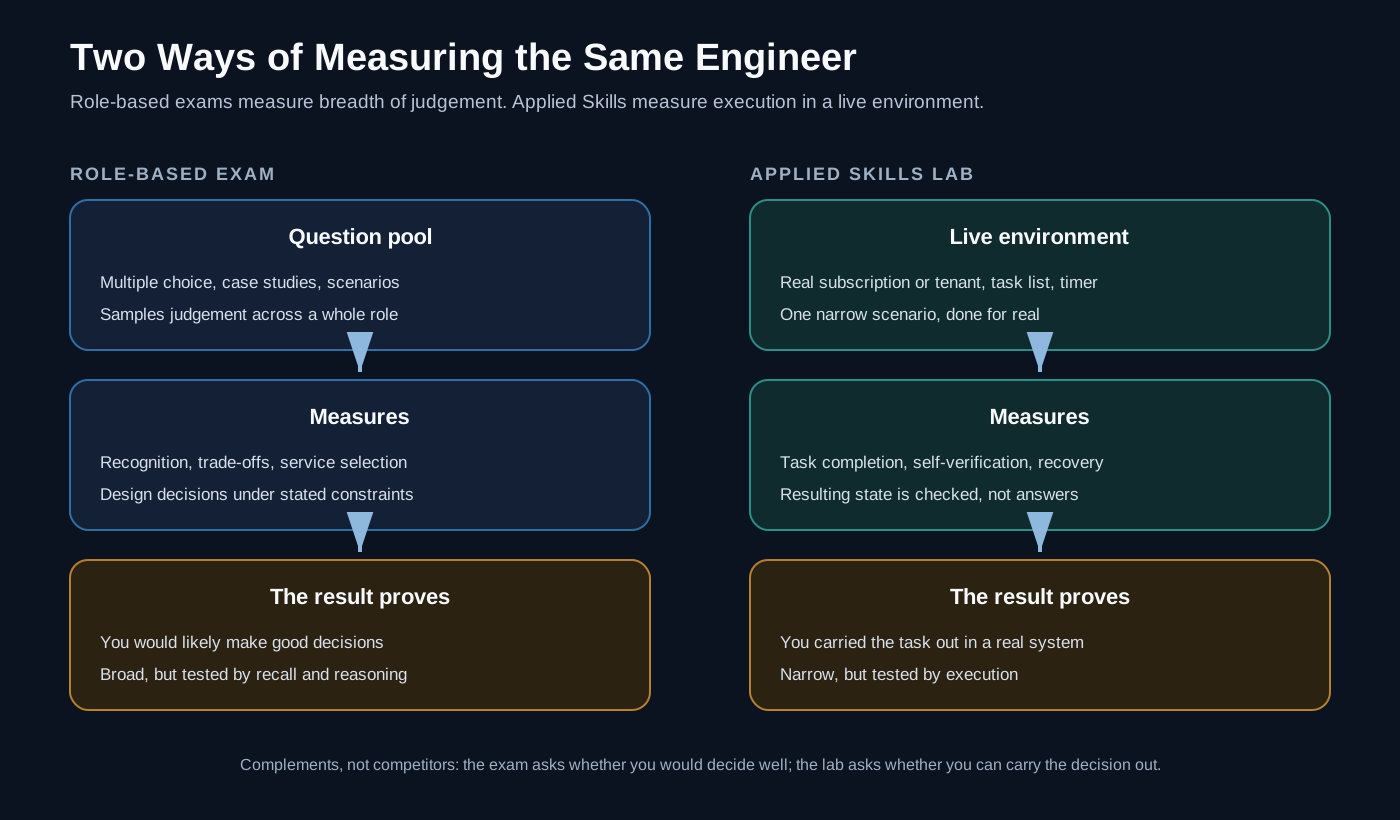
Nothing is simulated. If a task asks you to configure a retention policy, a pipeline or an agent, you configure the real thing, and the assessment checks the resulting state — not which radio button you would have picked.
What the lab format measures
A role-based exam samples your judgement across an entire role: architecture trade-offs, service selection, constraint handling, edge cases. It measures breadth, mostly through recognition.
An Applied Skills lab measures something narrower and, in some ways, more honest:
- can you navigate the actual product surface, not a diagram of it;
- can you translate a written requirement into a completed configuration;
- can you verify your own work before moving on;
- can you recover when the environment does something you did not expect.
That last one matters more than people expect. Live environments behave like live environments. Deployments take time, portals refresh, defaults change. Part of what the format quietly tests is whether you stay methodical when the lab is slower or slightly different from the documentation you learned from.
What it does not measure
Applied Skills do not test why. There is no question asking you to justify a design, weigh cost against resilience, or argue for one identity model over another. The task list is the design; your job is execution.
They also do not test scale. Configuring something once in a clean tenant is not the same as operating it across thousands of users with change control, monitoring and an audit function watching. No assessment format captures that — but exams at least gesture at it through scenario questions.
So the two formats are complements, not competitors. The exam asks whether you would make good decisions. The lab asks whether you can carry a decision out.
Why 30 in ten days is possible
Each Applied Skills credential is deliberately narrow — one scenario, a handful of tasks. If you already work in an area daily, validating it is fast. Entra identities, pipeline security and Azure management tasks cost me very little study time because they are simply my job.
The time went where my day-to-day work does not reach:
- building and extending agents in Microsoft Foundry and Copilot Studio;
- integrating Model Context Protocol tools with agents;
- Real-Time Intelligence in Microsoft Fabric;
- Purview retention, eDiscovery and data loss prevention;
- getting properly hands-on with C# classes and properties rather than reading around them.
That is the real value of a narrow, cheap-to-attempt format: it lowers the cost of stepping into adjacent domains. I would not sit a full exam to explore Fabric. I will happily spend an evening in a lab.
What the batch itself says
Looking at the thirty titles as a set, the themes are hard to miss:
- agents are the new unit of delivery — Foundry, Copilot Studio, autonomous capabilities and MCP integration each get their own assessment;
- AI work is inseparable from security work — securing AI solutions, protecting information in Microsoft 365 Copilot and Defender coverage sit alongside the building-focused credentials;
- compliance is now an engineering task — Purview configuration is assessed the same way pipeline security is: do it in the environment, prove it works;
- the developer surface keeps widening — GitHub Copilot, Azure Load Testing through GitHub Actions and Container Apps all assume the platform and the pipeline are one system.
Microsoft ships Applied Skills faster than exams, so the catalogue is a reasonable leading indicator of where the platform is going.
Tactics that helped
A few practical notes for anyone attempting these:
- Read the whole task list before touching anything. Later tasks often depend on earlier resources; knowing the destination changes how you do step one.
- Verify as you go. The environment is real, so check the resulting state after each task instead of trusting the portal’s optimistic messaging.
- Do exactly what is asked. Over-engineering wastes time and can fail validation. The lab rewards precision, not creativity.
- Budget for provisioning waits. Some resources take minutes to deploy. Sequence tasks so waiting time overlaps with work, not with watching a spinner.
- Use the linked learning path selectively. If the domain is new to you, do the exercises; if it is adjacent to your daily work, skim for the product-specific details and go straight to the assessment.
Where they fit
My transcript now reads as three layers: role-based certifications for breadth of judgement, Applied Skills for verified hands-on execution, and the learning paths underneath both as the record of study.
None of it is a scorecard. The platform never stands still, and the honest reason to keep doing these is the same one I gave on my Microsoft certification journey page: the assessments force me to revisit what I think I know, and to spend real time in the domains next door.
The lab format just happens to be the most honest test yet of whether the knowledge survives contact with a real environment.